Eleni Pitari-Pangalou
Touching Space
March 12, 2026–May 9, 2026The Breeder Feeder, Athens
The work of Eleni Pitari-Pangalou forms a coherent and multi-layered visual system, in which drawings and oil paintings shape a unified, recognizable universe. The two mediums complement each other, highlighting distinct but interrelated aspects of an artistic practice with a clear theoretical orientation and conceptual consistency. Otherworldly landscapes, floating figures, and scenes with ambiguous temporality constitute an iconographic field that activates symbolic and psychological associations. The painted surface is treated as a space for the condensation of experiences and imaginary projections, where the representational starting point is transformed into an internalized, contemplative narrative.
Born in Istanbul in 1905 to a wealthy family of the Greek diaspora, she grew up in an environment where art, travel, and access to European museums were a natural part of everyday life. The family’s relocation to Athens after the Asia Minor Catastrophe and her enrollment in the School of Fine Arts in 1926, at a time when such choices were not at all common for a young woman, reveal a personality determined to claim her place in the art world. Her brief apprenticeship with Nikolaos Lytras and, above all, her joining Konstantinos Parthenis’ workshop in 1929, laid the foundations for an artistic language that would strike a balance between symbolism, expressionism, and a gradual departure from formal representation.
Throughout the post-war period, Pitari-Pangalou regularly participated in group exhibitions, mainly presenting oil paintings—landscapes, still lifes, portraits, and allegorical scenes. She herself perceived her shift towards abstraction as an organic development of the “Parthenis School” (the teachings of Parthenis) and spoke with confidence about the spontaneity, sincerity and power of her work. At the same time, she held solo exhibitions and participated in important events in Greece and abroad, which attests to the recognition she enjoyed during her artistic career.
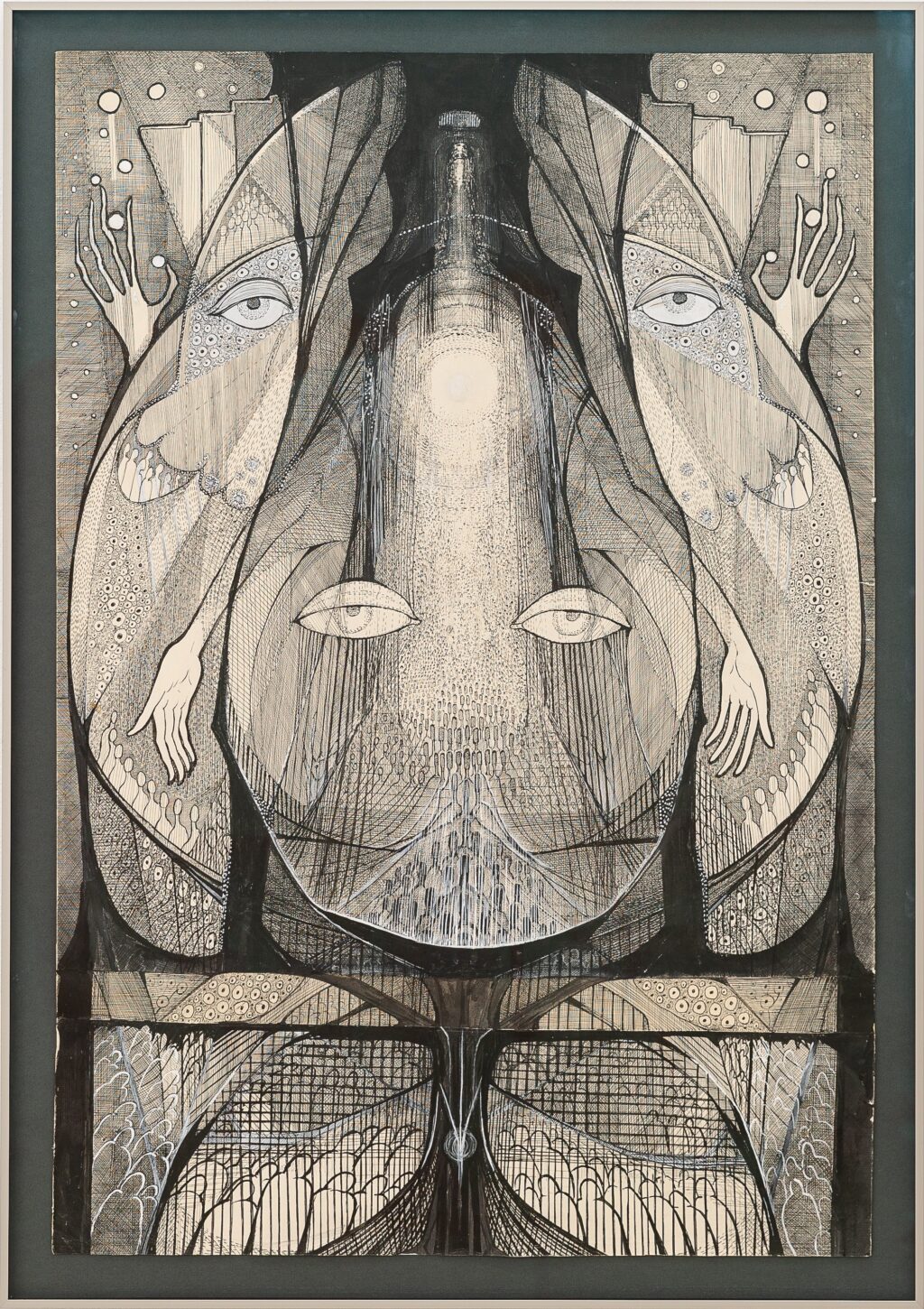
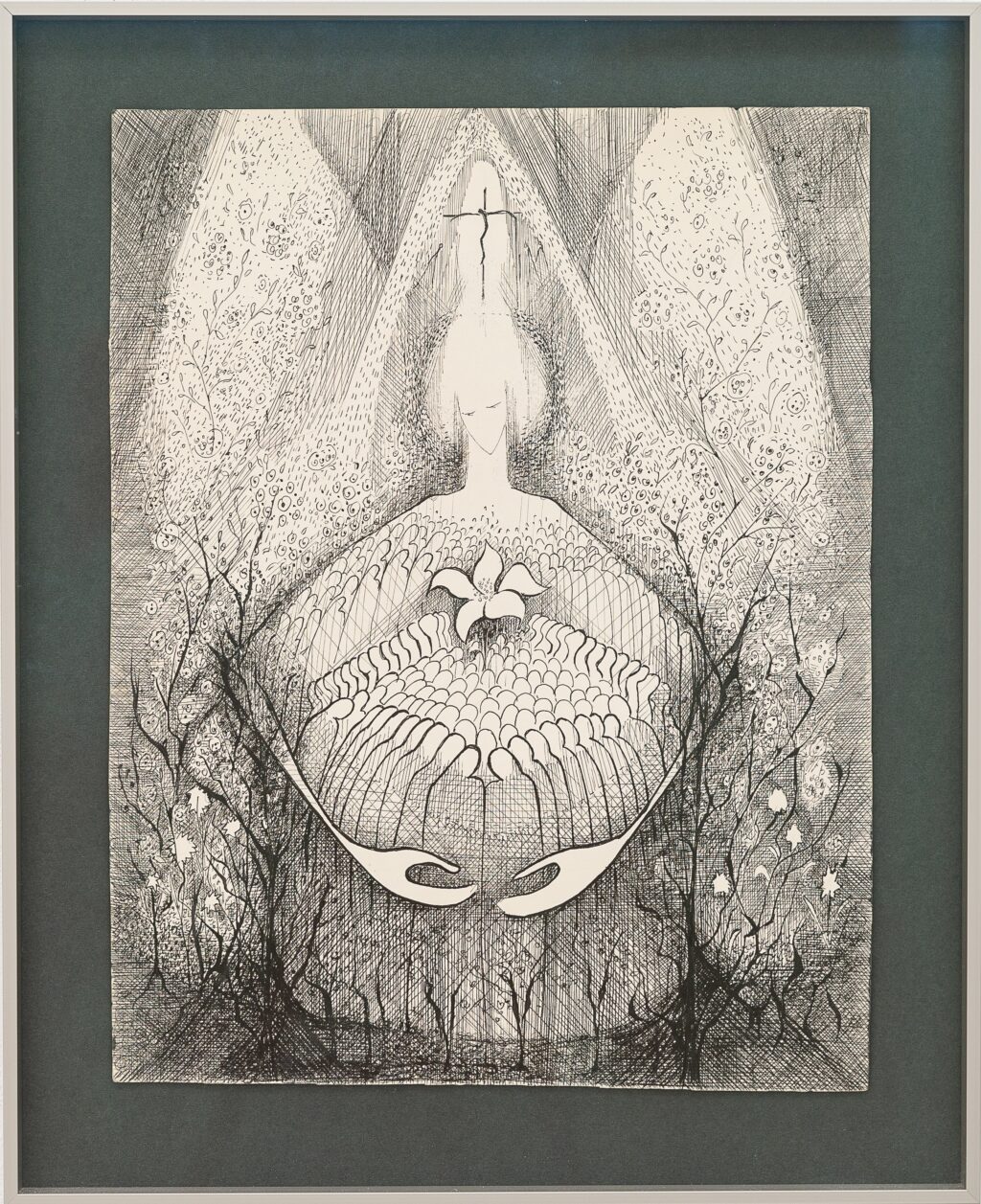
However, her most radical and personal body of work seems to have emerged in the 1960s and 1970s through black-and-white ink drawings on paper. These are works that function as internal maps: imaginary spaces, hybrid forms, and repetitive patterns are organized into high-intensity compositions. The surface is engaged in its entirety, creating images that exist between control and spontaneity. The dense coverage of the surface, bordering on horror vacui, suggests an obsessive need to capture, as if the artist was trying to hold on to something that constantly eludes her. The drawings from this period are a pivotal chapter in her practice and clearly encapsulate her visual vocabulary.
The oil paintings on display interact directly with the drawings. With their blurred, diffused light and indeterminate perspectives, they seem to convey the same metaphysical concern in the realm of color: the landscape is not a place but a state of mind, an intermediate space where matter becomes a vehicle for energy and memory.
Most of her works are often dominated by a central source of light—a disc, a sun, a spiral core—which functions both as the focal point of the composition and as a metaphysical landmark. Fluid forms, sometimes anthropomorphic and sometimes immaterial, are gathered around it, like traces of presences that emerge from the color and then immediately dissolve. The sense of futurism here does not arise from technological references, but from a cosmological imagination: the paintings seem to depict landscapes of another time or a different universe, where the human form has been transformed into energy.
At the same time, both in the drawings and in the oil paintings, the emphasis on the circle, symmetry, and repetition refers to ritual structures and primordial narratives. The figures often appear to be raising their hands, offering, invoking, or transforming, as if participating in a collective, almost cosmic ritual. Within this somberness, a subtle, underlying sense of humor creeps in: the slightly awkward or exaggerated figures, which discreetly undermine any metaphysical grandeur, defuse the scene and lend the work an unexpected tenderness, balancing between the mystical and the human.
This exhibition at The Breeder, following the solo presentation of Eleni Pitari-Pangalou’s drawings at ΕΜΣΤ in 2024, serves as a targeted reacquaintance with her artistic practice, which ranged beyond the dominant narratives of modern Greek art. This focused presentation unveils an artist with a clear artistic identity and an autonomous and coherent body of work, whose contribution can now be credibly reintegrated into the broader map of Greek modern painting.
Text by: Anna Mikoniati: Art Historian – Curator ΕΜΣΤ
Eleni Pitari-Pangalou (Istanbul, 1905 – Athens, 1995) studied at the Athens School of Fine Arts, under Nikolaos Lytras and Constantinos Parthenis. From 1939 on she actively began to participate in group shows organised by various collectives and associations in Athens, as well as several editions of the Panhellenic Art Exhibition, then held at Zappeion (1939-1975).
In 1963, Pitari-Pangalou was among the artists who represented Greece in the 7th São Paulo Art Biennial and the 5th Alexandria Biennale for Mediterranean Countries. In 1950, she presented her first solo exhibition in Athens at Zachariou Gallery. More solo exhibitions were organised by Nees Morfes Gallery (1959, 1963) and Medusa Art Gallery in Rome (1963). In 1995, she peacefully passed away in her home in Athens. In 2024 a solo exhibition showcasing her ink drawings on paper was held at EMST – National Museum of Contemporary Art Athens, curated by Anna Mikoniati, in the context of the exhibition programme What If Women Ruled the World?, reestablishing her practice within the contemporary art scene in Athens.